Dedicated Internet Access gives your business a fiber circuit reserved for you alone, backed by a service-level agreement with contractual commitments on performance and repair. Forward Konnect helps companies decide whether DIA is worth the premium over shared business fiber, checks availability at your address, and manages the order end to end.
No obligation. Local guidance. Response within one business day.
01
What "dedicated" actually means
Standard business internet — including good fiber service — is built on a shared model: your building or area draws on a common pool of capacity, and the carrier engineers that pool so it performs well for everyone. It works, and for most offices it is the right economic trade.
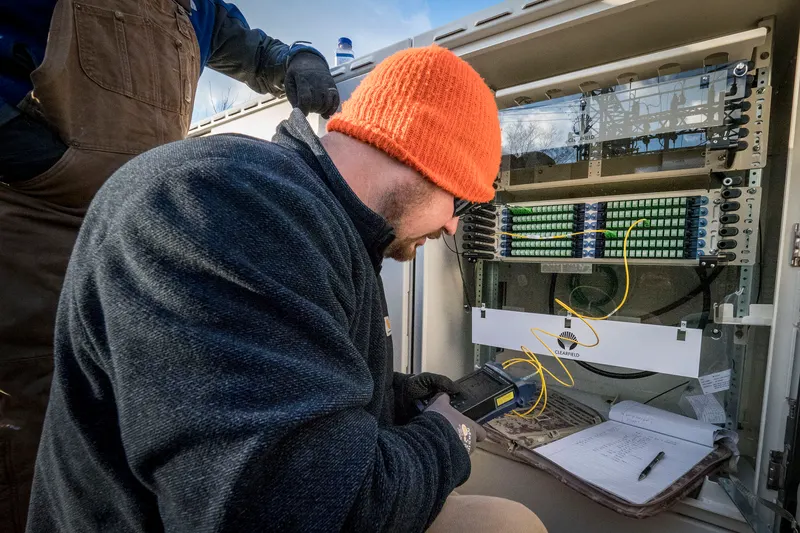
Dedicated Internet Access changes the model. With DIA, a fiber circuit and its full capacity are provisioned for your business alone. Nothing your neighbors do — a building full of tenants streaming, backing up, or having their own busiest hour — touches your bandwidth, because you are not sharing it with them. The capacity you contracted is the capacity you have, in both directions, at every hour of the day.
The second half of the product is contractual rather than technical: DIA comes with a service-level agreement. That distinction — engineered expectations versus contractual commitments — is the real difference between shared and dedicated service, and it matters more than any speed number.
The real difference between shared and dedicated service is contractual commitment, not a speed number.
02
The SLA: what you are actually buying
A service-level agreement turns "the carrier tries hard" into "the carrier is committed on paper." The exact terms belong to the current contract, so we will not fake precision here, but a business-grade SLA generally covers ground like this:
SLA area
What the commitment addresses
Availability
The uptime the carrier commits to, and remedies when it is missed
Performance
Expectations for how the circuit behaves, not just its size
Repair response
How quickly the carrier must engage when your circuit fails
Priority handling
Dedicated circuits ride a different support track than shared service
Remedies
What you are owed when a commitment is not met
On shared service, a hard outage means joining a support queue and waiting with everyone else. On DIA, the same outage triggers obligations. For a business where the connection is the business, that difference is what the premium buys.
On dedicated service an outage triggers obligations instead of a place in the queue.
03
Who genuinely needs DIA — and who does not
DIA costs more than shared fiber, and recommending it to everyone would be malpractice. The businesses where it earns its keep share a trait: an internet outage or slowdown immediately stops revenue or breaches an obligation. Typical examples:
Call-heavy operations running phones over the connection all day, where degraded quality is instantly audible to customers.
Companies hosting anything on-premises — systems, servers or services that outside users reach over the connection — where the business is unreachable when the circuit is.
Medical, legal and financial practices with obligations that do not pause for an outage, and upload-heavy work such as imaging or large file transfers.
Operations with hard cutoffs — logistics dispatch, trading-adjacent work, deadline-driven production — where an afternoon of instability costs more than a year of premium.
Offices where everything converged onto one connection: phones, payments, cameras, cloud apps. The more you stack on a single circuit, the stronger the case for that circuit carrying commitments.
Who usually does not need it: an office whose work would survive a rare bad afternoon. For those businesses, well-chosen shared fiber — see our AT&T Business Fiber service — delivers most of the everyday experience at a friendlier cost, and the honest recommendation is to keep the difference. Our job is to tell you which side of that line you are on, not to upsell you across it.
Our job is to tell you which side of the DIA line you are on, not to upsell you across it.
04
Static IPs and the technical extras
DIA conversations usually surface a cluster of technical needs, and static IP addresses lead the list. A static IP is a fixed public address that does not change — necessary or strongly preferable when you host anything reachable from outside, run site-to-site VPNs, restrict access to systems by address, or operate equipment that remote vendors must reach reliably.
Static IPs are not exclusive to DIA — they are available on other business services too — but businesses that need dedicated capacity and businesses that need fixed addressing are usually the same businesses. We sort out how many addresses you need and make sure the order includes them, along with the other design questions that come with a dedicated circuit: where it terminates, how your firewall and network hang off it, and whether anything about your building's wiring needs attention before installation.
Fixed addressing and dedicated capacity are usually needed by the same businesses, so both are designed together.
05
Pairing DIA with a backup path
A dedicated circuit with an SLA is still one physical circuit, and physical things can be cut, flooded or knocked out. Businesses that justify DIA usually also justify a backup connection on a different path — often wireless-based — so that even a hard failure of the primary leaves the office limping rather than stopped. Designed properly, failover happens automatically and the team barely notices.
We design the pair as one system: the dedicated circuit for committed everyday performance, the backup for continuity. If your operation spans more than one site, this design question multiplies, and our multi-location connectivity service handles the whole map at once.
A dedicated circuit and an independent backup path are designed as one system.
06
How Forward Konnect runs a DIA engagement
01
Fit conversation first
Before any availability check, we talk through what actually depends on your connection and what an outage costs you in practice. If shared service fits better, we say so at this stage — see business internet for how we handle that route.
02
Availability and build assessment
Dedicated circuits depend on fiber reaching your specific building, and sometimes on construction to close the gap. We check what can be ordered at your address and flag any build-out questions and their implications before you commit.
03
Current options, explained
Capacity levels, terms, SLA specifics, static IP blocks and backup design — presented side by side with trade-offs in plain English. Terms are current and address-specific, which is why nothing on this page pretends to quote them.
04
Order and installation management
DIA installations have more moving parts than shared service — site surveys, possible construction, equipment placement, testing. We own the timeline, coordinate every visit with your office, and confirm the circuit performs before you rely on it.
05
Life with the circuit
After go-live, we remain your first call — for escalations, changes and reviews. When the contract approaches renewal, our telecom cost audit puts the account in front of you with written findings instead of letting the term roll over silently.
The fit conversation comes before any availability check, and shared service is a valid answer.
07
Before you request a quote
The conversation moves fastest when you can sketch answers to these:
What runs over the connection today — phones, payments, hosted systems, cloud apps?
What does one hour of internet outage cost you, roughly — in dollars, missed calls or blown deadlines?
Do outside parties need to reach systems at your address?
Do you have a backup connection now, and has it ever been tested?
Any current contract end dates on existing service?
An address and honest answers to the first two are enough for us to tell you whether this page or the general business internet route is your starting point.
An address and honest answers about what depends on the connection are enough to start.
Check fiber availability for your address
Tell us where your business operates. We check current AT&T business service availability for the address and come back with real options — not a generic quote.
Common questions
Frequently asked questions
What is the real difference between DIA and regular business fiber?
Two things: capacity that is reserved for you alone instead of drawn from a shared pool, and a service-level agreement that makes performance and repair contractual commitments rather than engineering goals. Day to day both can feel fast; the difference shows at peak hours and, above all, when something breaks.
Is Dedicated Internet Access worth the higher cost for a small business?
It depends on what an outage costs you. If an hour offline means missed revenue, breached obligations or a silent phone system, the premium is insurance that pays for itself the first bad day. If your work would survive a rare rough afternoon, shared fiber is usually the smarter spend — and we will tell you which describes you.
Do I need DIA just to get a static IP address?
No. Static IPs are available on other business services as well, and if a fixed address is your only requirement, we will set that up without steering you into a dedicated circuit. The two get discussed together because businesses hosting reachable systems often need both — but they are separate decisions.
How long does a dedicated circuit take to install?
Longer than shared service, and it genuinely varies by building — site surveys, fiber construction if the building needs it, and equipment work all affect the timeline, so we do not quote a universal number. What we do commit to: after the availability check we give you a realistic expectation for your address, and we manage every step of it.
Can DIA at one site work alongside regular fiber at our other locations?
Yes, and that is a common design: dedicated service where the business cannot tolerate failure, shared fiber where economics win, and backup paths where they are justified. We check all of your addresses in one pass and design the mix deliberately — our multi-site work covers exactly this.
What happens if the carrier misses an SLA commitment?
The agreement defines remedies — that is much of the point of having one. The specifics live in the current contract terms, which we walk through with you line by line before you sign, so you know exactly what is committed and what you are owed if a commitment is missed. No surprises on the bad day.
Get AT&T Business Fiber for your business location with help from an authorized AT&T dealer. We check availability, compare current options and manage the order.
Business internet for growing companies: fiber where it reaches, real alternatives where it doesn't. We check your address, compare options, manage the order.
Connect every business location with one coherent plan: per-site availability checks, backup design and centralized billing, managed by one dedicated team.
Dedicated internet access reserves capacity for one business and adds SLA commitments. When shared business fiber is enough — and when DIA earns its cost.
What a static IP address is, which small businesses genuinely need one — servers, VPNs, cameras, whitelisting — and when dynamic plus alternatives is fine.
How to pair primary and backup business internet so outages never stop sales or phones — path diversity, failover hardware, sizing, testing and a runbook.
Find out if AT&T Business Fiber reaches your address
Send us your service address and we will check current availability and request the latest business options for you — no obligation.