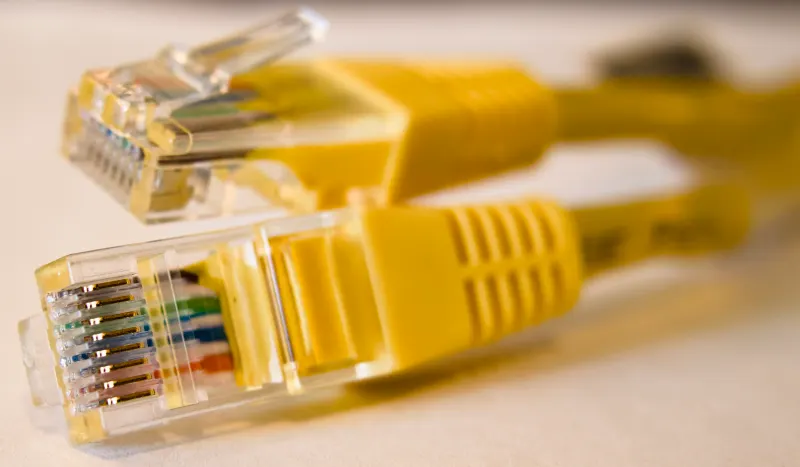
Forward Konnect sets up business internet for growing companies by starting from the work, not the technology — what your team does all day determines what the connection needs to do. We check what your address can get, fiber or otherwise, explain the trade-offs in plain English, and manage the order through to a live, tested connection.
No obligation. Local guidance. Response within one business day.
01
Start from the work, not the technology
Most guides to business internet start with technologies — fiber, cable, fixed wireless — and leave you to guess which one you are. We start at the other end. A ten-person accounting firm living in cloud software, a retail store whose card reader must never blink, a workshop that mostly needs email, and a creative agency pushing huge files upstream all have different requirements, and the right connection falls out of that conversation almost automatically.
That is the service on this page: for any business, we translate how your team works into connection requirements, check what your address can actually get, and set up the option that fits — whether that turns out to be fiber, something else, or a combination. Forward Konnect is an authorized AT&T dealer, so the checking, ordering and follow-up are handled by a dedicated team you can call back.
The right connection falls out of a conversation about how your team works.
02
The availability reality
Most areas are well served overall, but availability is decided address by address, not city by city. Fiber build-out follows streets and buildings unevenly: one side of an intersection can order it while the other cannot yet. Older office buildings sometimes have wiring that shapes what can be installed; newer developments sometimes have agreements with specific providers; suburban and industrial addresses each have their own patterns.
This is why we refuse to promise anything before checking. The first concrete step for every client is an address check against business systems — not a consumer coverage map — that tells us what can genuinely be ordered at your location. If you have several sites, we check them all in one pass; our multi-location connectivity service exists because the answers usually differ from site to site.
Availability is decided address by address, so nothing is promised before the check.
03
Fiber first, but not fiber only
When fiber is available at your address, it is usually the right call for an office that depends on its connection: it handles upload-heavy cloud work and video calls well, and it is the platform the carrier keeps building on. That path has its own dedicated page — AT&T Business Fiber — covering availability checks, ordering and installation.
But "fiber or nothing" is bad advice while build-out remains uneven. Depending on the address, workable setups may involve other wired business services or wireless-based connectivity, alone or combined. Two patterns come up constantly:
The bridge setup. Fiber has not reached the address yet. We set up the best available connection now, flag the address for build-out, and revisit when the situation changes — rather than letting the business limp along on whatever the previous tenant had.
The primary-plus-backup setup. The main connection is good, but the business cannot tolerate an outage — payments stop or phones die. We add a second connection on a different path, typically wireless-based, so one failure does not stop the workday.
And for businesses where connectivity commitments need to be contractual — guaranteed repair response, service-level agreements — the step up is dedicated internet access, which we assess in the same conversation.
Fiber is usually the first choice where it exists, and a workable setup exists where it does not.
04
Matching symptoms to likely fixes
If you already have business internet and it is not working for you, the symptom usually points at the cause:
What you are seeing
What it usually means
Fast mornings, crawling afternoons
Shared capacity contention, or a plan the headcount has outgrown
Video calls stutter while downloads seem fine
Upload capacity is the bottleneck — common on non-fiber connections
Everything stops when the internet blips
No backup path for a business that clearly needs one
Card payments or cloud apps time out randomly
Connection quality or equipment issues, not necessarily speed
The bill keeps growing but nothing improved
Contract drift — worth a cost audit before any new order
The table is a starting point, not a diagnosis. Part of our assessment is separating problems a new connection will fix from problems it will not — aging routers, Wi-Fi dead zones and internal network issues masquerade as "bad internet" all the time, and selling you a bigger circuit would not fix any of them.
A bigger circuit never fixes a problem that lives in the router, the Wi-Fi or the internal network.
05
How the engagement runs
01
Tell us the address and the pain
The form below asks for your service address and a few lines about what the business does and what is not working. That is genuinely all we need to begin.
02
We check and we listen
We verify what business services can be ordered at the address, and we have a short call about the work: headcount, applications, phones, payment systems, growth plans, tolerance for downtime.
03
Options on one page
You get the realistic choices for your address side by side — service type, term, and what each means for the problems you described. No stale price tables; current terms for your specific location, explained.
04
We run the order
Once you decide, we place the order, coordinate the installation window with your office, and stay on it until the connection is live and tested with your actual applications.
05
We stay reachable
Afterward you have a named contact for changes, questions and reviews — not a queue. Adding phones later is common, and the groundwork is already laid; see business phone lines for how that piece works.
Once the order is placed, a named contact stays with the connection until it is live and tested.
06
What this costs you
The address check, the assessment and the comparison cost nothing, and ordering through us adds no markup — the terms you accept are the carrier's current terms for your address. We are compensated through the dealer program, a relationship we describe openly on our dealer relationship page. If the assessment concludes that your current connection is actually fine, that conclusion is free too, and we will tell you what the real problem is instead.
When the current connection is actually fine, that conclusion is part of the assessment too.
07
Before you ask for a quote
You can start with nothing but an address, but the options conversation moves faster if you can answer a few things:
How many people are online at the busiest hour, and what are the heaviest applications?
Does the business take card payments or run phones over the connection?
What has actually gone wrong with the current setup — slowness, outages, both?
Are you under contract, and do you know when it ends?
Is a second location or a headcount jump likely in the next year or two?
Bring what you know; we work out the rest.
Check fiber availability for your address
Tell us where your business operates. We check current AT&T business service availability for the address and come back with real options — not a generic quote.
Common questions
Frequently asked questions
What kinds of internet can you set up if fiber is not available at my address?
It depends on the address, which is exactly why we check first. Depending on location, options can include other wired business services or wireless-based connectivity, sometimes combined as primary and backup. We tell you what your specific address qualifies for and what each option realistically handles — and if the best move is waiting for build-out on a bridge setup, we say that.
How do I know how much speed my business actually needs?
Count the busiest hour, not the average day: how many people online at once, what they are doing, and whether uploads matter — video calls and cloud backups push data out, not just down. We walk through this with you during the assessment, because buying by gut feel is how businesses end up overpaying or throttled.
Can you fix slow internet without switching providers?
Sometimes, yes. Slowness is often caused by equipment, Wi-Fi coverage or a plan mismatch rather than the provider. Our assessment separates what a new connection would fix from what it would not, and if the honest answer is "your connection is fine, your router is not," that is what we tell you.
Do you only serve businesses in one area?
No — we work with businesses wherever they operate, and availability is checked per address wherever you are. Since services vary block by block anyway, a suburban address is no different from a downtown one in how we handle it: we check it, then talk about what came back.
Will switching internet providers take my business offline?
Handled properly, no — the new connection is installed and tested while the old one is still active, and the cutover happens once everything works. We coordinate the installation window with your team and keep the overlap in place until you are confident, which is the point of having someone manage the order.
Get AT&T Business Fiber for your business location with help from an authorized AT&T dealer. We check availability, compare current options and manage the order.
Connect every business location with one coherent plan: per-site availability checks, backup design and centralized billing, managed by one dedicated team.
Fiber and cable differ in upload capacity, consistency under load, and scalability. How a growing company should weigh them — and when cable still makes sense.
A practical method for sizing business internet — inventory your real workloads, count concurrency, weigh uploads, add headroom — without overbuying capacity.
A practical troubleshooting sequence for Dallas offices with unreliable internet — document the pattern, rule out your own gear, then fix, upgrade or switch.
Find out if AT&T Business Fiber reaches your address
Send us your service address and we will check current availability and request the latest business options for you — no obligation.