There is no single honest number for how long business fiber installation takes, because the timeline is set by dependencies that vary per address — whether the building already has fiber facilities, whether construction and permits are needed, how quickly landlord approvals move, and how ready your own space is. This article breaks the process into its stages, shows which dependencies control each one, and explains how to compress the parts you can influence.
The honest answer up front
Anyone who quotes you a universal installation time for business fiber without knowing your address is guessing. The same order can be a quick, routine visit at one building and a multi-stage project involving engineering, permits and construction at another — and the two buildings can sit a block apart. That is not evasion; it is how physical infrastructure works. Fiber has to exist at your building, get from the street into the building, travel to your suite, and terminate on working equipment, and each of those four steps has its own owner and its own ways of taking longer.
So the useful question is not "how long does it take" but "which of the known dependencies apply to my address, and which of them can I influence?" This article answers that. Treat any date in a fiber project as conditional on the dependencies below being cleared — and plan your office openings and moves accordingly, with the current connection kept alive until the new one is proven. If you want the full ordering process end to end, our step-by-step guide to how to get AT&T Business Fiber in Dallas is the companion to this piece.
The four stages of every fiber installation
Every business fiber installation, fast or slow, moves through the same four stages. Knowing them lets you read order-status updates like an insider instead of waiting in the dark.
Stage 1: Order validation and engineering review. After the order is placed, the carrier confirms what serving the address actually requires: existing facilities, capacity, and how your suite will be reached. For a building already served, this is largely administrative. For anything else, this stage is where the real scope — and the real timeline — gets determined.
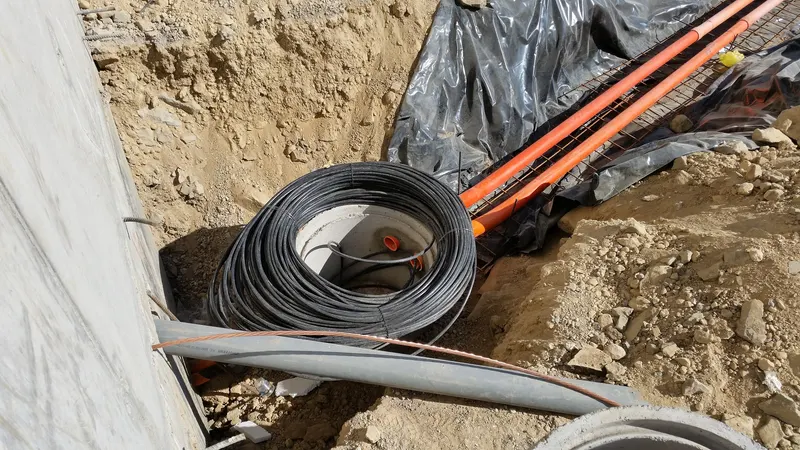
Stage 2: Construction and outside work, if required. If fiber has not yet reached your building, or existing facilities cannot support the order, physical build-out happens: extending fiber from the nearest serving point, trenching or boring, aerial runs, or work at the building's entrance facility. This is the stage with the widest variation, because it can involve permits, utility coordination and property agreements — none of which the customer or even the carrier fully controls.
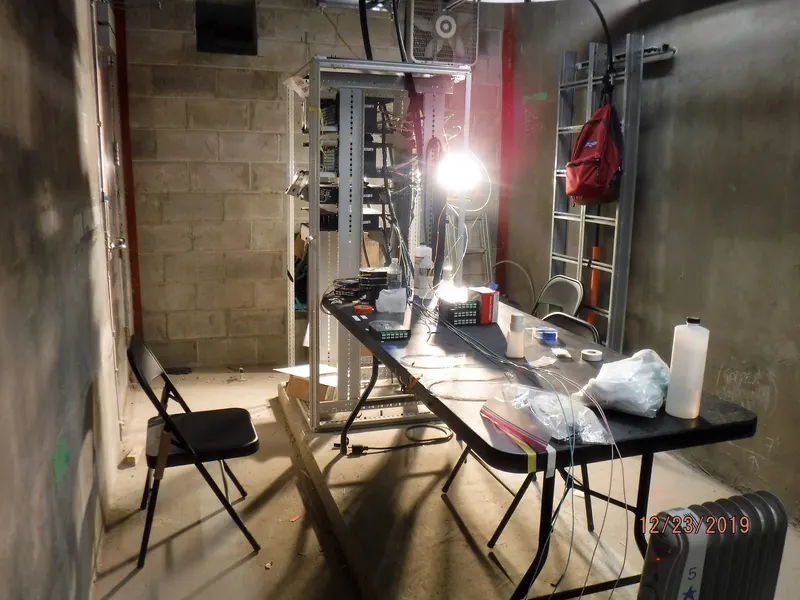
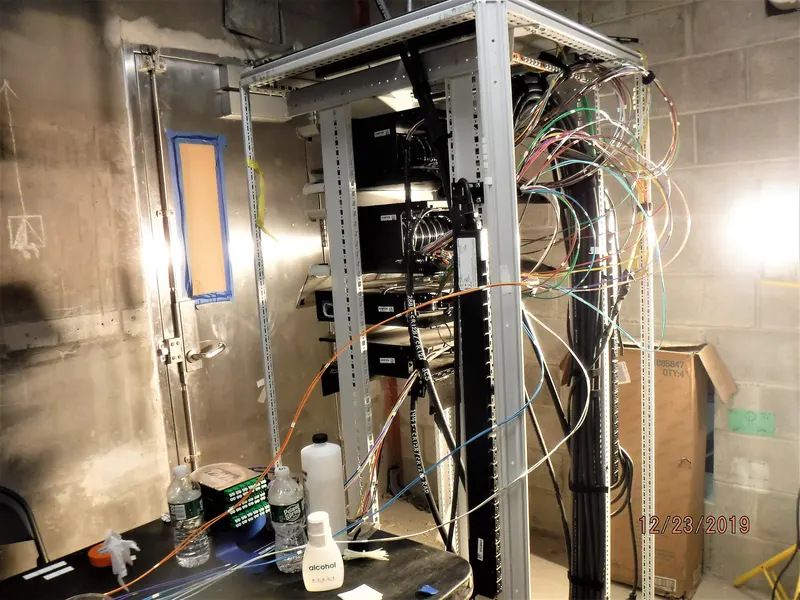
Stage 3: Inside work. Getting service from the building entrance to your suite: riser cabling, conduit, mounting the termination equipment where your network will connect. In a single-tenant building this is straightforward; in a multi-tenant tower it depends on riser access, building rules and landlord cooperation.
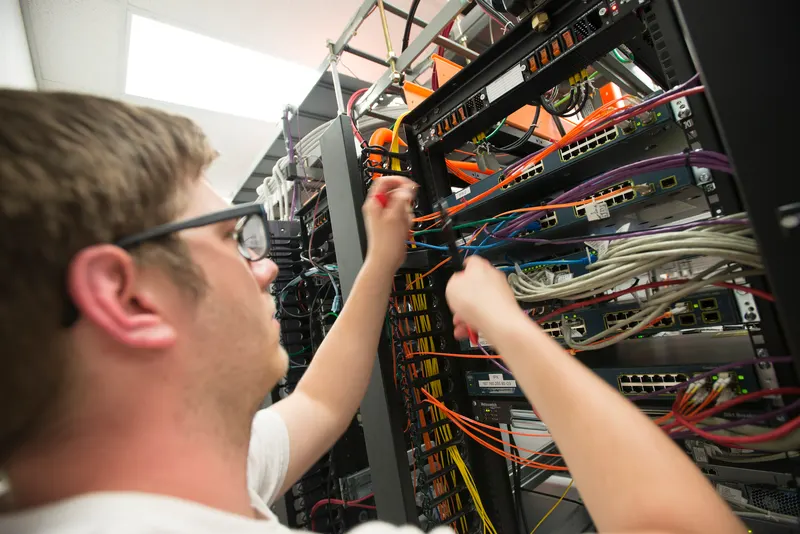
Stage 4: Activation and turn-up. The circuit is provisioned, tested and handed to you live. Usually the shortest stage — and the only one most customers ever see, which is why installation timelines feel so opaque from outside.
What controls the timeline: the dependency table
| Dependency | Who controls it | Effect on timeline | What you can do |
|---|---|---|---|
| Building already has fiber facilities | Reality at your address | The single biggest fork: lit buildings skip construction entirely | Check before leasing; weigh it in site selection |
| Construction and build-out scope | Carrier engineering | Trenching, boring or aerial work extends timelines substantially | Order as early as possible; have an interim plan |
| Permits and rights-of-way | City and property owners | Approvals move at their own pace | Nothing directly — which is why early ordering matters |
| Landlord consent and building access | Property owner or manager | Silent stall if not requested early | Request written consent the day you commit to the space |
| Riser and pathway condition | Building | Full or damaged conduit adds inside work | Ask the building engineer early; surface problems in Stage 1 |
| Order accuracy | You and your dealer | Wrong suite, contact or requirements cause rework | Verify every detail at order time |
| Your site readiness | You | Unready spaces turn install day into a reschedule | Power, space and equipment ready before the visit |
| Scheduling and demand | Carrier workload | Appointment availability varies | Take the first workable slot; be flexible on hours |
Notice the pattern: the items with the largest timeline impact — existing facilities, construction, permits — are the ones you influence least after ordering and most before it, through address selection and early ordering. That asymmetry is the core planning insight of fiber projects.
The fast path: buildings that are already served
When a building already has fiber facilities with capacity — common in newer commercial stock and buildings where other tenants already take service — the project skips Stage 2 entirely. What remains is validation, inside work and activation, and the timeline is dominated by scheduling and your own readiness rather than by infrastructure.
Whether your building is on this fast path is knowable before you order, and even before you lease: it is part of what a proper availability check establishes. What determines serviceability at a given Dallas address — build-out, facilities, capacity — is a topic of its own, covered in our article on AT&T Business Fiber availability in Dallas. The practical takeaway here: if you are choosing between two comparable spaces, their fiber status is worth real weight in the decision, because it can be the difference between a routine install and a construction project.
The slow path: when construction enters the picture
If the availability check comes back with construction or build-out questions, recalibrate expectations immediately — not to despair, but to realism. Construction timelines depend on engineering design, permits from the city, coordination with other utilities, agreements with property owners along the route, and the physical work itself. Weather can move dates. None of these steps publishes a schedule, and no one can honestly guarantee a completion date while they are pending.
Three planning rules for the slow path:
- Never put a construction-dependent circuit on your opening-day critical path. Plan the business around an interim connection — another available service type or a wireless solution — and let fiber arrive as an upgrade rather than a blocker.
- Keep the order moving anyway. Construction only finishes if it starts; the earlier the order goes in, the earlier every approval clock begins.
- Ask for status at the dependency level. "Waiting on permit" and "construction scheduled" are useful updates; "in progress" is not. Whoever manages your order should be able to tell you which stage you are in and what it is waiting on.
This is also where a local partner changes the experience. As a Dallas-based authorized AT&T dealer, Forward Konnect places and then tracks orders — chasing the stalled step instead of letting silence accumulate — through our AT&T Business Fiber service in Dallas. The construction itself moves no faster, but stalls get noticed in days instead of weeks, and you always know which dependency you are waiting on.
Compress what you control
You cannot dig the trench, but a surprising share of total elapsed time in fiber projects is consumed by customer-side and building-side items that are entirely compressible:
- Order early. Every dependency clock — engineering, permits, landlord consent, scheduling — starts at the order, so the cheapest acceleration available is simply starting sooner.
- Clear the landlord immediately. Written consent for installation and technician access, requested the day you commit to a space. In multi-tenant buildings this is the most common self-inflicted delay.
- Get the building facts early. Entrance facility location, riser condition, conduit space, work-hour rules, insurance requirements for contractors. Surfacing a full riser in week one beats discovering it on install day.
- Have your side ready. A powered, secure termination location; your router and network equipment configured; inside cabling done; a reachable decision-maker on install day. Our phase-by-phase installation checklist for a new office covers this readiness work item by item.
- Answer fast. When the carrier or dealer asks a question — site contact, access window, mounting location — same-day answers keep the order out of the parking lot.
Teams that do all five routinely experience the same infrastructure timeline as everyone else but far shorter total projects, because the waiting happens in parallel instead of in sequence.
One more compressible item hides in plain sight: decision speed on your own side. Orders stall for days while a company debates the speed tier, the static IP question or where the equipment closet goes. Settle those choices before or immediately after ordering — with whoever owns the budget in the room — so that when the carrier is ready to move, nothing on your side is still a meeting.
Planning a move or opening around the uncertainty
Since fiber dates firm up late, sequence the project so that uncertainty is survivable. Order as soon as the address is committed. Set the opening date on things you control, with connectivity as a tracked dependency rather than an assumption. Keep the old office's service alive until the new circuit has carried real workdays — overlap is cheap insurance. And if the new office takes payments or runs phones over the internet, install a wireless failover from day one; it doubles as the interim connection if fiber runs long, and as outage protection forever after, a design covered in our guide to primary and backup internet planning.
A Dallas-specific note: the metroplex's construction boom cuts both ways. Fiber build-out keeps reaching new corridors, which improves the odds for any given address over time — but active development can also complicate permits and access in the short term. Both are reasons the availability picture is checked fresh, per address, at order time rather than assumed from last year's answer.
The bottom line
Business fiber installation takes as long as its slowest dependency, and the dependencies are knowable: whether your building is already served, whether construction and permits are involved, how fast the landlord moves, and how ready your own site is. Check availability before you lease if you can, order the moment the address is committed, clear building approvals in week one, prepare your space in parallel, and keep an interim and backup plan so no opening date rests on a trench. You cannot control the timeline — but you can control whether the waiting happens in sequence or in parallel, and that is usually the difference between a footnote and a crisis.